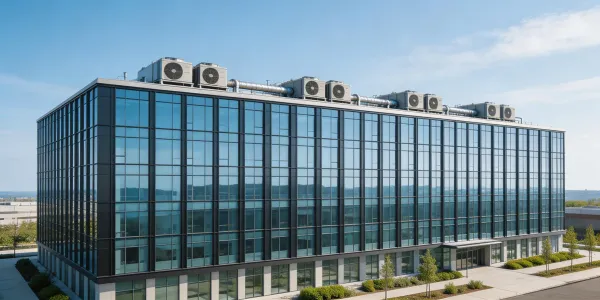
Commercial Buildings
Air-source and water-source heat pumps for office complexes, shopping centers, hotels, and mixed-use developments. Simultaneous heating and cooling with heat recovery for maximum energy utilization.
- Capacity range: 50 kW to 2 MW per unit
- SCOP up to 4.3 in moderate climates
- BMS integration via BACnet / Modbus
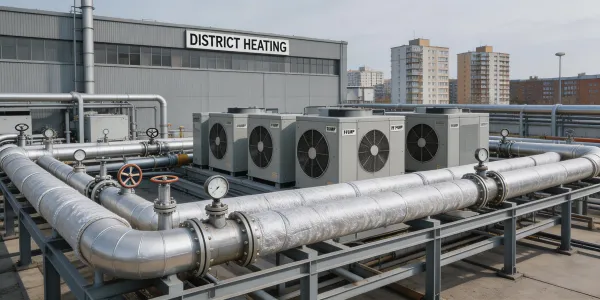
District Heating Networks
Large-scale heat pump stations for municipal and campus district heating networks. Ground-source and sewage-source heat recovery systems delivering base-load thermal energy at utility scale.
- Capacity: 500 kW to 10 MW cascade systems
- Supply temperatures up to 80 degrees Celsius
- Integration with thermal storage tanks
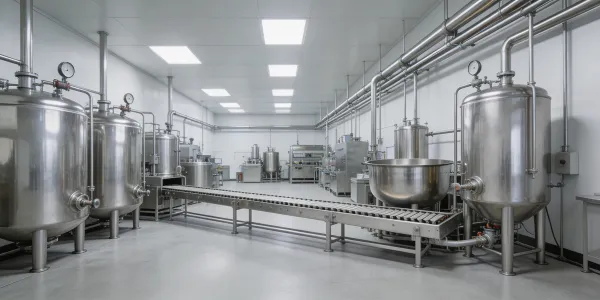
Food & Beverage Processing
Simultaneous process heating and cooling for pasteurization, fermentation temperature control, and CIP water heating. Heat recovery from refrigeration systems to preheat process water.
- Hot water output up to 90 degrees Celsius
- HACCP-compatible equipment design
- Stainless steel heat exchangers standard

Data Centers
Reversible heat pump systems for precision cooling with waste heat recovery. Free cooling mode activation below 12 degrees Celsius ambient. Hot aisle containment integration for PUE optimization.
- Cooling capacity: 100 kW to 5 MW
- Chilled water supply at 7/12 degrees Celsius
- Waste heat recovery for district heating
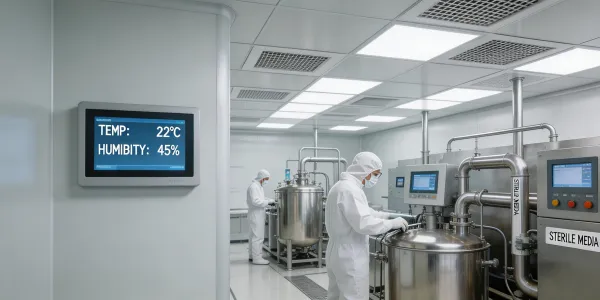
Pharmaceutical Manufacturing
Precision temperature control for cleanroom environments, API storage, and lyophilization processes. Redundant heat pump configurations with N+1 backup for GMP-compliant facilities.
- Temperature stability: plus or minus 0.5K
- Secondary glycol loop (zero leak risk)
- Full GxP documentation support
Industrial Process Heating
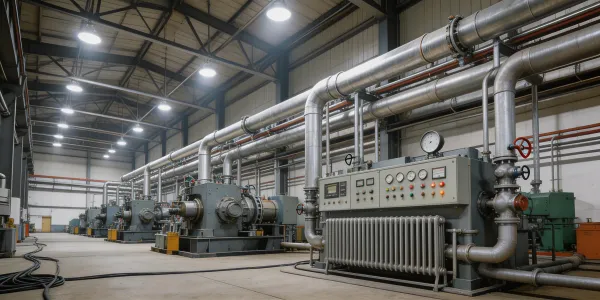
High-temperature heat pumps replacing steam boilers in chemical processing, textile manufacturing, and paper production. Transcritical CO2 cascade systems for supply temperatures exceeding 80 degrees Celsius.
- Supply temperature up to 90 degrees Celsius
- CO2 transcritical cascade technology
- Integration with existing steam networks
Application Case Studies
District Heating Retrofit — Municipal Network, Northern Germany
A 12,000-household district heating network in Schleswig-Holstein was operating on aging gas-fired boilers installed in 2003, facing rising carbon tax liabilities under the German Federal Climate Change Act (2019 revision). The utility operator required a phased transition to electrified base-load heating without disrupting service during the 6-month heating season.
GreenHeat deployed four 2.5 MW ground-source heat pump modules in a cascade configuration, integrated with a 500 m3 thermal storage tank. The system draws heat from a treated wastewater source at 12-15 degrees Celsius year-round and delivers supply water at 70 degrees Celsius to the existing distribution network. Installation occurred during the 2023 summer window with full commissioning completed by September.
Result: The heat pump station now provides 65% of the network's annual thermal demand, reducing natural gas consumption by 8.2 million kWh/year and lowering CO2 emissions by 1,640 tonnes/year. The system operates at an average annual COP of 3.9, with the thermal storage buffer enabling off-peak electricity purchasing that reduces operating cost by an additional 18% compared to real-time tariff operation.
Pharmaceutical Cleanroom — GMP Facility, Basel Region
A mid-sized pharmaceutical manufacturer operating ISO Class 7 cleanrooms for injectable drug production required simultaneous heating and cooling with temperature stability of +/- 0.5K across 4,200 m2 of controlled environment. The existing chiller-plus-boiler setup consumed 1.8 GWh/year and created maintenance complexity with two separate refrigerant circuits.
GreenHeat installed a reversible water-source heat pump system rated at 800 kW cooling / 950 kW heating with a secondary glycol loop to eliminate refrigerant presence in the cleanroom zone. The system uses R-32 refrigerant with a total charge of 48 kg, well below the 52 kg threshold for the facility's ventilation capacity under EN 378. GreenHeat Connect monitors condenser and evaporator approach temperatures in real time, triggering maintenance alerts when fouling exceeds 0.0002 m2K/W.
Result: Unified heating and cooling reduced total energy consumption by 34% (612 MWh/year savings). Temperature stability improved from +/- 1.2K to +/- 0.4K, exceeding the specification. The secondary glycol loop eliminated refrigerant leak risk within the GMP zone, simplifying the facility's environmental qualification documentation.
Material and Method Trade-offs in Heat Pump Selection
Choosing the right heat source and system architecture involves balancing efficiency, cost, and site constraints. The table below summarizes the key trade-offs our engineering team evaluates during the project scoping phase.
| Heat Source | Typical COP | Capital Cost | Best Suited For | Key Limitation |
|---|---|---|---|---|
| Ambient air | 3.2-4.5 | Lowest | Commercial HVAC, retrofit projects with limited site access | COP drops below 2.5 when ambient falls below -10 degrees Celsius; defrost cycles reduce seasonal efficiency by 5-10% |
| Ground (borehole) | 4.0-5.8 | Highest (drilling cost) | District heating, facilities with stable year-round demand | Requires geological survey; borehole depth 80-200m per 50 kW; ground thermal depletion risk in heating-dominant climates without seasonal recharge |
| Surface water / sewage | 3.8-5.2 | Medium | Utility-scale district heating, coastal or riverside installations | Fouling and corrosion on heat exchangers; water extraction permits required; seasonal temperature variation affects part-load performance |
| Waste heat recovery | 4.5-7.0 | Medium (depends on source integration) | Data centers, industrial co-location, supermarkets | Dependent on consistent waste heat availability; temperature and flow variability requires buffer storage |
Not sure which solution fits your application?
Request an Application Assessment