GreenHeat Connect IoT Platform
Cloud-based fleet management for heat pump systems. Real-time COP tracking, automated fault detection, and predictive maintenance scheduling powered by machine learning algorithms trained on 50 million+ operating hours of thermal data.
- Real-time performance dashboards per unit and fleet
- AI anomaly detection with 72-hour advance warnings
- Automated energy performance reports (monthly/quarterly)
- Mobile app for field technicians with augmented diagnostics
Natural Refrigerant Platforms
Our entire product roadmap is built around zero-compromise natural refrigerant systems. R-290 (propane) for commercial applications, R-32 for high-capacity systems, and transcritical CO2 (R-744) for industrial high-temperature heating.
- R-290: GWP of 3, ideal for 20-200 kW applications
- R-32: GWP of 675, suitable for 100-800 kW systems
- R-744 CO2: GWP of 1, cascade systems up to 90 degrees Celsius
- Full F-Gas Regulation and Kigali Amendment compliance
Variable Speed Inverter Technology
All GreenHeat compressors feature variable speed drives that modulate capacity from 15% to 100% load. This eliminates the efficiency losses of fixed-speed on/off cycling and maintains optimal COP across the full operating range.
- 30-50% energy savings vs. fixed-speed at partial loads
- Soft-start reduces inrush current and mechanical stress
- Precise temperature control (+/- 0.5K)
- Extended compressor lifespan through reduced cycling
Smart Grid Integration
GreenHeat systems are designed to participate in demand-response programs and time-of-use energy optimization. Built-in thermal storage integration allows shifting heating loads to low-tariff periods without compromising occupant comfort.
- SG-Ready compatible (German Smart Grid standard)
- OpenADR 2.0 support for demand response
- Thermal buffer tank management algorithms
- PV self-consumption optimization mode
Research & Development
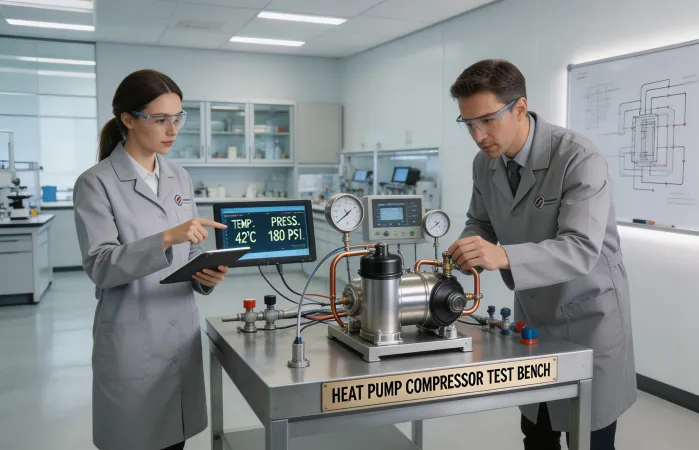
Our 62-member R&D team operates from dedicated laboratories in Stuttgart equipped with calorimetric test chambers, compressor endurance test rigs, and a full-scale thermal system simulation environment. We invest 8% of annual revenue in research focused on three strategic priorities:
Pushing heat pump supply temperatures beyond 90 degrees Celsius to displace more fossil-fuel boilers in industrial processes.
Machine learning models that predict building thermal demand 24 hours ahead and pre-emptively adjust heat pump operating parameters.
Vapor injection, ejector-assisted, and two-stage compression architectures that extend COP performance in extreme ambient conditions.
Technology Selection Considerations
Selecting the right heat pump configuration involves engineering trade-offs that depend on your specific application, climate, and load profile. Below are two key decision points our engineering team evaluates with every client.
Natural Refrigerants vs. Synthetic Low-GWP HFOs
The Kigali Amendment and EU F-Gas Regulation are accelerating the phase-down of high-GWP HFCs. The industry remains divided on the optimal transition path:
| Criterion | Natural Refrigerants (R-290, R-717, R-744) | Synthetic HFOs (R-1234yf, R-1234ze) |
|---|---|---|
| GWP | 0-3 (near-zero) | 1-4 (very low) |
| Long-term cost | No patent dependencies, lower operating cost at scale | Patent-protected, higher refrigerant replacement cost |
| Safety profile | R-290 flammable (A3), R-717 toxic (B2L) — requires engineered safety systems | Mildly flammable (A2L) — compatible with existing safety infrastructure |
| Retrofit compatibility | Requires new system design for charge limits and ventilation | Drop-in or near-drop-in for many existing HFC systems |
| Technician training | Specialized certification required for flammables and toxics | Existing HVAC technician skill sets largely transferable |
GreenHeat platforms are engineered primarily for natural refrigerants (R-290, R-32, R-744). However, we recognize that retrofit projects and certain regulatory environments may favor HFO-based solutions in the near term. Our engineering team helps clients evaluate the total cost of ownership and regulatory trajectory for each option.
Variable Speed (Inverter) vs. Fixed Speed Compressors
Inverter-driven compressors offer modulating capacity but at higher capital cost. The breakeven depends on load variability, energy prices, and application type:
| Criterion | Variable Speed (Inverter) | Fixed Speed |
|---|---|---|
| Part-load efficiency | 30-50% energy savings at typical 40-60% load conditions | On/off cycling causes 15-25% efficiency loss at part load |
| Capital cost | 15-25% higher upfront due to VFD and controls | Lower initial investment, simpler control architecture |
| Temperature control | Precise modulation (+/- 0.5K), critical for pharma and data centers | Wider temperature swing (+/- 2-3K), acceptable for comfort heating |
| Maintenance complexity | VFD boards require specialized service; harmonic filtering may be needed | Simpler diagnostics, widely available replacement parts |
| Ideal application | Variable-load: offices, hotels, district heating, data centers | Constant-load: industrial process heating, ice making, base-load systems |
While GreenHeat standardizes on inverter technology for its efficiency advantages, fixed-speed compressors remain a valid engineering choice for constant-load industrial applications where payback on the VFD premium exceeds the equipment lifecycle. We help clients model the breakeven point using site-specific load profiles and local energy tariffs.
Interested in a Technology Partnership?
We collaborate with universities, utility companies, and building developers on pilot projects for emerging heat pump applications.
Contact Our R&D Team